Mahabba on Cross Rhythms' Breakthrough! Nights

Image: Joanthan Velasquez, Unsplash

Image: Joanthan Velasquez, Unsplash

Mahabba on Cross Rhythms' Breakthrough! Nights

Gordon, National Director for Mahabba Network, was on Cross Rhythms' Breakthrough! Nights radio show last night, speaking about the work of Mahabba.

Breakthrough! Nights focusses on the people, issues and initiatives of the Stoke on Trent area and occasionally national and global topics.

It offers a chance for people, Christian or not, to engage spiritually through contemporary worship, prayer, the prophetic and sharing amazing life changing stories.

Gordon answered a series of questions, including:

  • What response is the Network getting from the Muslim community?
     
  • If Islam is in the news, like most things, it's usually for bad news and in Islam's case it's usually terrorism. You don't often hear of people talking about loving Muslims in the media. So please tell me about your love for Muslims
     
  • What do Muslims experience from their families and faith community when they want to change their faith and become Christians?
     
  • How understanding is our Government and services, of the issues Muslim converts face?
     
  • The Government has recently ended the scheme bringing child refugees to Britain, having taken just 350 of the promised 3,000. What is your opinion of this?

The full interview will be available shortly as a Q&A article, so stay tuned, but you can listen again to the show here.

Listen again

Gordon was speaking to Heather Bellamy, and if you want to tune into Cross Rhythms, Breakthrough! Nights is on every Tuesday evening, and available on FM or online.

Jesus & Muhammad

Image: Adam Przewoski, Unsplash

Image: Adam Przewoski, Unsplash

Jesus & Muhammad

Local Mahabba members were involved with another Meeting for Better Understanding (MBU) between Muslims and Christians the other night.

The discussion was to do with Jesus and Muhammad.

Individuals had been praying hard for the Holy Spirit to move in this particular mosque, which practises a strict form of Islam.

There have been a number of previous MBU’s, but little outward signs of warming to the Gospel.

On the night, about 80 people, mainly Muslims, heard a clear Gospel presentation and took evangelistic literature.

Questions and discussion about Muhammad and Jesus clearly gave Muslims present much food for thought, some of them a little troubling, as they challenged their current beliefs about Jesus.

Christians continue to meet up with their Muslim friends, so please pray for them as they build relationships and share Jesus, particularly as the Gospel stirs people's hearts and minds with questions and promptings.

Your turn

Have you been inspired?

Why not get in touch with your local Mahabba prayer group, get praying and see where God leads you?

Learn More

How to answer key questions from Muslims

Image: Emily Morter, Unsplash

Image: Emily Morter, Unsplash

How to answer key questions from Muslims

Denise has been building relationships with Muslims, and sent in the following question, wanting to know how she can bring her faith into conversations with grace and truth.

How can I get equipped to ask - and answer - the right questions when talking to Muslims?

Dear Mahabba,

I have a good Muslim friend, and we have been talking about faith and building friendship for several years. I was recently invited to the mosque open day, and spoke to the imam and my friends for two hours.

However, although I came away feeling much more informed, I felt ill-equipped to ask the right questions - especially to do with the fundamental differences between Islam and Christianity.

These included, the sonship and divinity of Jesus;  the Trinity; reliability of the Qur'an and Bible; and more besides!

Can you help or point me in the right direction? I would really appreciate it!

Many thanks,

Denise


Our response

Hi Denise,

Thanks again for your message, and great to hear that you are building relationships and have been able to visit your local mosque successfully.

In terms of your questions, there are a handful of suggestions:

  1. Connect with someone at your local Mahabba group
     
  2. Browse the helpful articles on Christianity Explained website
     
  3. Join The City and enquire of others there
     
  4. Connect with Applied Biblical Christianity (ABC)
 

Local Mahabba group

There are individuals in local Mahabba groups who are doing exactly the same things as you and working through the same challenges. A local group is an excellent place to get support from others with more experience.

Find a group
 

Christianity Explained website

There are many websites available with articles and resources on how to answer common questions and points raised by Muslims. Check out the articles on explaining Christianity to Muslims and various hot topics.

Christianity Explained
 

Join The City

You can also apply to join The City, the Mahabba online community area, where you can pick the brains of lots of other Christians who are engaged in the same issues as you. This is good if there is no local group near you, and there is a wider pool of people to ask.

The City
 

Connect with ABC

Acts of kindness definitely help to build new relationships, but what do you do when the Qur'an says:

Jesus did not die on the cross, neither was he the Son of God, the third person of the Trinity, or God

'How to share the Gospel with Muslims' is a useful document from ABC which can help lead to opportunities to share the Gospel, as well as answering the usual questions.

Also available from ABC as a PowerPoint for teaching in small groups or churches. [N.B. scroll to bottom of downloads page.]

How to share the gospel

I hope that helps!

Let me know if you need any further help,

Simon

Elliot's Weekly Round-up: Hijabs, frustration, Birmingham & asylum

female Muslim athletes are delighted
— http://www.telegraph.co.uk/fashion/brands/nikes-first-high-performance-hijab-coming-female-muslim-athletes/

This is the big news that Nike are set to launch a sports hijab in 2018. The material it is made from has lots of little holes to ensure breathability.  It will be available in three colours. This demonstrates haw big business is becoming more aware of the Muslim pound. We too, as the church, need to become more aware of those around us.

#DearSister
You must be married by age______
What about my goals and aspirations?
Sister, your goal should be to serve your husband
(UGH)
— http://www.bbc.co.uk/news/world-africa-39179674

A recent report states how Muslim women are frustrated about being told how to dress and behave. Women's comments in the article are very different to the often assumed repressed role.  

The second episode of Extremely British Muslims is on Channel 4 this Thursday.  The last episode was about the struggle to find a spouse using family connections, mosque matchmaking services, and Muslim dating sites.  This episode homes in on what it is like for young men growing up as Muslims in Birmingham. It highlights their difficulties when travelling internationally, their aid work with refugees in Greece, along with discussion of why some people become radicalised.

“You have people who are ex-bad boys who still have that gang mentality. And if you want to be in a gang, what’s the biggest gang in the world right now?

“ISIS is the biggest, baddest gang in the world. You can get an AK and get forgiven by God at the same time.
— http://www.birminghammail.co.uk/news/showbiz-tv/terrorists-why-extremely-british-muslims--12641261

Perhaps their conclusion is the most noticeable- and is a challenge.

“I know we have got to do more too, we have to work harder to mix. My community needs to be more outward looking.

“It’s up to all of us.”
— http://www.birminghammail.co.uk/news/showbiz-tv/terrorists-why-extremely-british-muslims--12641261

Finally a video that informs and may challenge preconceptions of asylum seekers.  Life as an asylum seeker here is tough.  Let's respond with Jesus love.

Where does god gain more honour?

Image: Jacob Meyer, Unsplash

Image: Jacob Meyer, Unsplash

Individuals from a local Mahabba prayer group have been involved in running a meeting for better understanding (MBU). 30 Muslims attended the event with Christians and heard the Gospel very clearly.

A Muslim speaker made a very startling statement, quoting from Deuteronomy 21:23.

Whoever hangs on the wood is cursed by God

He went on to say:

For this reason, it is impossible for us to believe that Jesus died on the cross. God would never allow such a terrible thing to be said about one of the greatest prophets

The Christian speaker succeeded very well in building the Gospel precisely on this truth:

Jesus took the curse that had been caused by our sin and paid the punishment of death on our behalf

It was clear that from a Muslim perspective, the death of Jesus is a great sign of God’s weakness.

Therefore, it is very important to emphasise that:

The Gospel does not finish with the curse and death of Jesus, but continues with the lifting of the curse by his resurrection!

A great question to ask Muslims regarding this central issue is:

Where does God gain more honour, by preventing the death of Jesus, as it is described in the Q uran, or by raising him from the dead, as described in the Bible?

The answer is self evident.

For more helpful answers and resources on how to speak with grace and truth to Muslims, check out the Christianity Explained website.

Learn More

New Testaments & Gospels in other languages suitable for refugees and asylum seekers

Image: Raul Petri, Unsplash

Image: Raul Petri, Unsplash

Info on new testaments & gospels in other languages suitable for refugees and asylum seekers

Do you have any info on New Testaments & Gospels in other languages suitable for refugees and asylum seekers?

Mahabba Gloucester has created a helpful sheet!

N.B. prices are subject to change and are correct as of the time of publication of this blog.

1. Amazon www.amazon.co.uk

  • Arabic/English New Testament, £2.80 (£3.27 plus postage)

  • Biblica are holders of the NIV copyright

  • NIV Luke’s Gospel £0.50 (and free shipping for orders of over £10.00)

2. Operation Mobilisation (OM) www.uk.om.org

  • Store in Halesowen

  • Telephone 0121-5855662 - Cecil Benjamin knows about Asian languages best

  • Large stock with English/Urdu Luke's Gospels in packs of 100

3. The Bible Society biblesociety.org.uk

  • Based in Swindon, telephone 01793 418100

  • Urdu New Testament £1.25

  • Bengali New Testament £8.40

  • Punjabi New Testament £8.05

  • English/Russian £19.00

  • English/Arabic £5.00

  • English/Chinese £5.00

  • English/Spanish £7.00

4. Kitab www.kitab.org.uk

  • Andrew Howell, telephone 01908 552714

  • New Testaments or Gospels in other languages

  • Luke in Arabic £0.85

  • Diglot New Testament in Arabic £6.50

  • Luke in Gujarati

5. The Bible Society www.bsni.co.uk

  • Northern Ireland, 028 9032 6577

  • Bi-lingual New Testaments: English/Arabic, English /Chinese, English/Hungarian, English/Polish and English/Spanish

6. Gospel Publishing Mission www.gospelpublishingmission.org

  • Is God really my Father? English/Arabic and pictures for use in teaching, £4.50

  • N.B. check pictures for suitability

7. Bible websites with foreign languages

Entertaining angels

Image: Samantha Sophia, Unsplash

Image: Samantha Sophia, Unsplash

Entertaining angels

I remember whilst travelling in Israel/Palestine many years back arriving in a town at night.

We were travelling by car, two of us, looking for somewhere to stay.

We asked a local for directions and ended up being invited to his home, where we were welcomed and given food and somewhere to sleep.

We also got to meet his family the next morning over breakfast.

This incident had a profound effect on me, as I was on the receiving end of what has been called the ‘kindness of strangers’.

This is something I, like many others, have experienced frequently as I travel.

This is also the chosen title of journalist Kate Adie's autobiography.

Maybe you can also think of incidents where you have been on the receiving end of hospitality...

In ‘Cool Britannia’ we can be somewhat slower in offering hospitality.

And it seems that, post-Brexit, incidents of Hate Crime are increasing, as reported in the Independent recently.

Xenophobia is on the rise in Britain (literally the fear of the stranger/foreigner).

The Bible encourages us to ‘practice hospitality’ thereby ‘entertaining angels unawares’ (Hebrews 13:2 ESV). An intriguing phrase…

Do not neglect to show hospitality to strangers, for thereby some have entertained angels unawares
— Hebrews 13:2 ESV

The answer to xenophobia is to respond in the opposite spirit – ‘philoxenia’ which is the Biblical (Greek) term for generosity or hospitality.

It literally means love of strangers and foreigners.

Go on try it. Practice generosity or hospitality with a stranger.  And maybe just maybe you will encounter an ‘angel’...

Phil - an Anglican minister, who is also a Street Angel, and a part of Mahabba

My new passport

My New Passport

My new passport just arrived in the post. Time for a trip. Perhaps a long haul destination, maybe a sunny beach to top up my tan, I guess would even consider a cultural/historical tour. Probably not a cruise though!

I didn’t need the shiny new passport for the train ride to my friend’s house. After eating, a game of Monopoly, and a couple of hours in bed I was ready for the off by 5:30am. A few hours down the road and we joined another friend and continued together.

What destination was worthy of the new passport and early start? Here’s a clue… it’s a place that many of my friends have been through, somewhere that has often been in the media,  a well-known location although no one wants to stay. It’s a place that over 10,000 called home until a few months ago. Now a home to none, although police still patrol the area. 

Welcome to the Calais Jungle! Running next to the road we could see the fence that cost millions to build.

We visited a warehouse that sprung up in 2015 as a response to a Facebook appeal. From then on volunteers have provided clothing, sleeping bags, wood for cooking as well as meals for those in The Jungle.

Since the dismantling of The Jungle the size of their work has downscaled, but they are still helping those in a nearby camp of Dunkirk. The energy, enthusiasm and commitment of the volunteers was inspiring. They continue to grapple with difficult questions such as how to assist unaccompanied minors returning to the region yet not to be seen to be encouraging others to return.

Later we arrived at the site that was once home to 10,000. As soon as we alighted from the car a van full of police descended to ask if we were journalists.

Hardly anything remains at the site. Empty cardboard boxes, spent tear gas used to disperse residents, first aid points, and white shipping containers used to house the most vulnerable. where asylum seekers could be carried before being met by the emergency services who were afraid to enter.

It was strange to see some of the graffiti that I was so familiar with from the media. Other graffiti spoke of people’s desperation and challenged inactivity.

After surveying the ghostly site we met up with a local Catholic group who welcome asylum seekers.

One of the group whom had been making a documentary tracking different individuals progress, another was a long term volunteer who had spent many years cooking for hundreds of people. A couple of refugees acted as our interpreters as our school French was rather rusty.

A trip through the Channel Tunnel, Tube across London, train ride, and half an hour walk and I was home. Travelling with that new passport was easy. How much easier was my onward travel than many of those who have had prolonged stays in the Calais Jungle.

I’ll leave you with thought I read in a magazine last summer…

It is our calling as Church to practise hospitality. Fear is the greatest enemy of hospitality.

Key finds on Muslims and Islam from Pew Research Center

Image: José Martín, Unsplash

Image: José Martín, Unsplash

The Pew Research Center has been compiling a number of recent reports, answering key questions about Muslims.

  • There were 1.6 billion Muslims in the world as of 2010 – roughly 23% of the global population
     
  • Although many countries in the Middle East-North Africa region are heavily Muslim, the region is home to only about 20% of the world’s Muslims
     
  • In 2015, there were 3.3 million Muslims of all ages in the U.S., or about 1% of the U.S. population
     
  • Our Pew's demographic projections estimate that Muslims will make up 2.1% of the U.S. population by the year 2050
     
  • The two major factors behind the rapid projected growth of Islam are:
     
    • Muslims have more children than members of other religious groups. Around the world, each Muslim woman has an average of 3.1 children, compared with 2.3 for all other groups combined
       
    • Muslims are the youngest (median age of 23 years old in 2010) of all major religious groups, seven years younger than the median age of non-Muslims. As a result, a larger share of Muslims already are, or will soon be, at the point in their lives when they begin having children
       
  • Perceptions of Muslims varied across European nations:
     
    • Majorities in Hungary, Italy, Poland and Greece say they view Muslims unfavorably
       
    • Negative attitudes toward Muslims are much less common in France, Germany, the United Kingdom and elsewhere in Northern and Western Europe
       
    • People who place themselves on the right side of the ideological scale are much more likely than those on the left to see Muslims negatively

The full report can be found on the Pew Research Center website.

Read More

Elliot's Weekly Roundup: statistics, something to pray about & is love in the air?

Image: Laura Ockel, Unsplash

Image: Laura Ockel, Unsplash

In the media this week: statistics, something to pray about and is love in the air?

Islam is the only religion growing faster than the world’s population and it will be the largest in the world by 2070, researchers have found.
— telegraph.co.uk

The article also includes information about European attitudes towards Muslims. Reading this could be seen as overwhelming.  But let's make a choice not be overwhelmed by numbers and statics. Instead lets take the increasing opportunities that present themselves to share Jesus to those around us.  Even though the report states that attitudes to Muslims are not so negative in the UK there is still much room for us to model good relations and to help to shape attitudes positively.

Majorities in Hungary, Italy, Poland,and Greece say they view Muslims unfavourably, while negative attitudes towards Muslims are much less common in France, Germany, the United Kingdom and elsewhere in Northern and Western Europe.
— telegraph.co.uk

Meanwhile a new project has been started by four newspapers in Europe documenting conditions experienced by refugees and asylum seekers.  It states that Britain is one of the worst destinations for people seeking asylum in Western Europe. The following video clip shows the desperate reality of asylum seekers- many of whom are Muslim.  The question that it left me thinking about is how can I respond as an individual/ as a family/as part of a church/ as a British citizen.  Come on let's help make this place more welcoming!

The UN is warning that thousands of Rohingya children are suffering as "indirect victims" of the crackdown against suspected militants in Burma. Let's continue to pray for a change in this situation.

There is going to be a new TV programme on Channel 4 starting on Thursday. The first programme follows young men and women as they attempt to find spouses with the help of family, dating sited and the mosque marriage bureau.  It is set in Birmingham where:

...a baby boy is more likely to be called Mohammed than any other name...
— bradfordzone.co.uk

The second programme deals with growing up as a young Muslim in the shadow of the news.  The third programme is about the rules of Islam and how they are interpreted.

In an insightful article, the creator of the show explained how the programme was made as a response to her daughter asking: "Mummy, what's a terrorist?"  She states the challenge of growing up as a Muslim in a post 9/11 world. " We grew up with Rosie and Jim, they are growing up with Jihadi John." 

...we did want to put ourselves in a Muslim community and explore and record the day to day lives and experiences of ordinary Muslims in the UK.

 I think I'll watch it. Pray.  Then use the insight gained from the programme in my interactions with my Muslim friends. Why don't you do the same. Let me know how you get on!

News from Harrow - Prayer on the Streets

Image: Herry Lawford, Flickr

Image: Herry Lawford, Flickr

Thanks to the Mahabba Peterborough for passing on this story of God moving among Muslims in Harrow!

News from Harrow - Prayer on the Streets

By Clare Lambert, Stanmore Baptist Church

Taking the Gospel out onto the streets can be an uncomfortable prospect but, for eight years, a small team from our church in Harrow has been praying for healing and sharing the gospel with our neighbours.

We set up Healing on the Streets out of a sense of urgency - if they would never come in, we needed to get out!


We set up Healing on the Streets out of a sense of urgency as we realised that what we did in the building would not touch the majority of people walking past. If they would never come in, we needed to get out! It was the supernatural element of our faith that we were convicted to take onto the streets and Healing on the Streets, who pioneered this ministry, were able to provide the training that we needed.

Our method is simple. We meet outside Sainsbury’s, on the High Street, where we set up a banner, some chairs and refreshments and hand out flyers. Our approach is gentle and respectful. The simple phrase "we’re here to offer prayer", for example, can stop a person in their tracks. We’re always mindful of working in partnership with God and it’s a privilege to do so.

Harrow is the most religiously diverse local authority in the UK and this is a wonderful way of connecting with our neighbours since our consistent weekly presence has created community. Most people come specifically for prayer, either as a one-off or on a regular basis. Others come for coffee and a chat and this often leads to prayer too. We have many testimonies of healings and answers to prayer and some people have come to the Lord.

A Muslim woman comes regularly after her husband’s cancer was healed through prayer elsewhere. She is being drawn to Jesus


One woman, from a Hindu background, was feeling isolated. She experienced healing and found community with us. She has subsequently given her life to Jesus. A couple, also Hindus, came to us when the husband was diagnosed with a large tumour. This man encountered Jesus as we prayed and the subsequent operation revealed an unexpectedly small and benign growth which was easily removed. The couple praised Jesus for that intervention. A Muslim woman comes regularly after her husband’s cancer was healed through prayer elsewhere. She is being drawn to Jesus.

We are very aware that the Holy Spirit is already at work and that He brings people to us. This enables us to minister from a place of peace and with an understanding of the delegated authority we have in Jesus’ name to move in the gifts of the Spirit. All followers of Jesus can do this!

YOUR TURN

Have you been inspired?

Why not get in touch with your local Mahabba prayer group, get praying and see where God leads you?

Learn More

Thank you - BMS event

Image: Simon Ingram, Flickr

Image: Simon Ingram, Flickr

Mahabba was part of the recent equipping and encourage 'Helping Christians engage with Muslims' event and received the following feedback:

Dear Mahabba,

My husband and I attended the excellent Mahabba West event at BMS Birmingham on Saturday.

We would like to express our thanks for putting on this event and enabling us to hear about some of the ways God is using folk to love Muslims for his sake.

I especially enjoyed the session on Ethics by Louise Brown and was glad to hear from Roxy and obtain a copy of the DVD course, Joining the Family.

The lunch was excellent too, although the dining room was very noisy!

Your sincerely,

Barbara

Thanks, Barbara!

If you want to find out about other upcoming events, do visit our events page.

Learn More

Bibles for refugees

Image: Colin Carey, Unsplash

Image: Colin Carey, Unsplash

Hi Mahabba,

A quick question - do you have any good contacts from which we could obtain Amharic and Tigrinya bibles for refugees we are working with?

Have a Great Day,

Andy

The Bible Society stocks common language Bibles in Amharic and Tigrinya, as a first start.

Amharic is the main language of Ethiopia and Tigrinya (ትግርኛ) is spoken in Eritrea and northern Ethiopia.

The Amharic common language edition was published by the Bible Society of Ethiopia in 1980. The Tigrinya Bible is published in a Common Language edition.

Amharic
Tigrinya

Seven ways the church can engage with the refugee crisis

Image: hunters_green, Flickr

Image: hunters_green, Flickr

Last week Trustee Adam and Hub-Regional Rep Elliot attended the Refugee Highway Partnership's annual European roundtable in Budapest, representing Mahabba Network and Community Church Derby.

The Refugee Highway Partnership aims to 'help the church serve forcibly displaced people'. For the last 10 years it has run a European-wide Roundtable to bring together Christian organisations and workers in the refugee sector to share ideas and network.

Adam commented that there were six main things that impacted him:

1. Recognise the clear biblical mandate to love and serve refugees

We can discuss politics and policies, but there is no avoiding the priority God puts on his people welcoming the stranger, practising hospitality, feeding the hungry, binding up the broken-hearted and sharing the Gospel with lost people.

Are we known for doing this?

2. Accept the extent of the crisis we're living in

As keynote speaker Patrick Johnstone explained, the mass migration we are experiencing isn't likely to end soon, but it is one of the biggest challenges facing the church in Europe today.

There were 1,170,145 asylum applications in EU countries in 2016. Germany has received over half of these. 300,225 came from Syria, with significant numbers from Afghanistan and Iraq.

Some of the poorest countries in Europe have borne the heaviest load of people in transit. Croatia had 660,000 travelling through during a six-month period.

In contrast the numbers arriving in the UK are relatively few.

We have a responsibility to shape the conversation around refugees in British society conveying God's compassion and challenging attitudes based on prejudice and fear.

It's ironic that some of those most vocal about preserving British Christian values are most reluctant to follow Christ's command to love the stranger.

3. Consider ethics in refugee ministry

There was a helpful exploration of the issues around coercion and opportunism caused by the power imbalance between refugees and the churches or organisations serving them.

We need to think through the ethical and cultural aspects of our work. Not that we should avoid sharing our faith or ministering to refugees, but we need to be aware of the pitfalls and regularly monitor our practices to see if we are in any way abusing our position of privilege and power.

We need to consider how can we create some reciprocity in the relationship and transparency in our operations. This will help build trust with secular organisations and authorities.

4. Find church responses to cultural diversity

It was interesting to hear how churches in Europe are responding to the arrival of refugee Christians and converts. There was a recognition that the ideal was to work towards some form of integration into host churches.

Some German churches have a model of a single church with several branches. These would hold services in different languages but share buildings, resources and often youth work.

Whilst it was recognised that some ethnic groups will find it easier to meet as a separate church, we need to work to build strong relational bridges with them and allow a flow of people between our churches as their congregations become increasingly settled in our culture and language.

Where refugees are finding a home among us we should look for ways to give them roles and responsibilities rather than remain in a place of dependency. We need to avoid the naive assumption that the acquisition of language removes the cultural barriers between us.

A concept of ‘interclusion’ was proposed: a process of bringing people together from various cultures into a dominant host culture where they feel accepted, appreciated, understood and valued. They are accepted as equals and there is a shared goal of creating harmony within the values of God's kingdom.

At the same time their identities and cultural uniqueness are affirmed. This is a complex, but important topic for us to explore. It really highlights the importance of training our leaders in cross cultural awareness.

5. Embrace the unprecedented missional opportunities

There is no doubt that God is working in the midst of this refugee crisis to bring many from unreached peoples to himself.

We heard how rural churches in Finland have welcomed refugees and their churches are filling with Afghans. It is estimated that over 1,000 Afghans in Finland have turned to Christ which is over 10% of the total number of Afghan refugees there! A Pakistani convert shared how 12 Pashtuns have come to faith in his church in Germany.

Despite this remarkable openness there is a reluctance to witness to refugees in some circles, perhaps born out of a fear of offending or abusing their vulnerability.

We need to work at developing practices that are true to both the great commission and the great commandment. There are some astonishing resources available like the 5fish smartphone app that can present a clear Gospel message in multiple languages combining visual and audio media.

6. Sow into short term missions opportunities available within Europe

As well as the important work being done by agencies and European churches, short term teams have a valuable part to play.

We need a thorough approach to training in cultural sensitivity, responses to trauma and appropriate evangelistic approaches.

Now is an opportune time to establish links in countries such as Greece, where churches are engaging with refugees, and work into Turkey where the discovery Bible studies (DBS) method is being used with great success.

So what now, here are some suggested actions from Adam and Elliot.

Actions

  • Look for opportunities to celebrate the impact (even if it is smll to begin with!) you have within the wider context of the refugee crisis
  • Clarify guidelines around ethical engagement with refugees. Communicate this with cross cultural workers
  • Work with suitable charities to ensure those working with refugees have appropriate training about the effects of trauma
  • Train people in the use of app based multilingual evangelism resources
  • Look into missions opportunities in eastern Europe and Turkey
  • Research and develop vision and strategy for culturally inclusive churches

Lausanne Feature on Mahabba in Missions Catalyst

The Lausanne article on Mahabba Network made it into the popular Missions Catalyst news brief e-mail compiled by Pat Noble.

Missions Catalyst is a free, weekly electronic digest of mission news and resources designed to inspire and equip Christians worldwide for global ministry.

Missions Catalyst have picked up on the article that Gordon Hickson wrote for Luasanne:

Prayer-based Relational Network Equips “Ordinary” Christians for Ministry to Muslims

Over the last year or so, Christians across the UK have been confronted with a sudden escalation of media accounts of the actions of extremist Muslims, with stories of terrible atrocities and bloodshed in Iraq and Syria.

What has shocked them even more is that British Muslims by the hundreds have gone out to these war zones to give their support to ISIS and other extremist groups.

Many Christians have focused on the effects of Islamization and on the persecuted church, responding with fear and alienating themselves from face-to-face interaction with their Muslim neighbors.

In this context, a new phenomenon networking both agencies and churches has proved to be a catalyst to unity and prayer.
This prayer-based relational network is called Mahabba ('love' in Arabic); and it has flourished over the last four years, mainly because of the unprecedented opportunity in the UK. Its emphasis is on motivating and mobilizing “ordinary” Christians rather than just “specialists” to reach their Muslim neighbors.

The model is a prayer-based relational network which equips local churches with mentoring and training materials, and which helps church leaders to train ordinary members of their churches to relate to Muslims in love and be able to explain the gospel clearly.

Read full article
January issue Lausanne Global Analysis
Sign up to Missions Catalyst

Global distribution of Muslims from Pew Research Center

Image: Pew Resarch Center

Image: Pew Resarch Center

The Pew Research Center has published research on the distribution of Muslims worldwide.

Here are the main headlines:

  1. As of 2010, there were an estimated 1.6 billion Muslims around the world, making Islam the world’s second-largest religious tradition after Christianity
  2.  Nearly two-thirds (62%) of Muslims live in the Asia-Pacific region
  3.  More Muslims live in India and Pakistan (344 million combined) than in the entire Middle East-North Africa region (317 million)
  4. Middle East-North Africa region has the highest concentration of Muslims of any region of the world: 93% of its approximately 341 million inhabitants are Muslim
  5. The country with the largest number (about 209 million) is Indonesia, where 87.2% of the population identifies as Muslim
  6. Center estimates that by 2050 the number of Muslims worldwide will grow to 2.76 billion, or 29.7% of world’s population

Read the article in full on the Pew Research Center website.

Read more

Elliot's round-up: change my heart

Here’s Elliot’s take on this week’s media trawl. Lets start off with an an inspiring video.

What a fantastic story. Lets pray for many hearts to be changed. Jesus start with mine.
 
Others too may have had preconceptions challenged as they attended 'Visit My Mosque Day'.

Lets pray for greater understanding, compassion and boldness to share Jesus with everyone we encounter.

We are white, European, Christian

So says a Mayor in Hungary. Looks like some he didn’t take the opportunity to have his thinking challenged or to see things from another point of view.

What about me. Do I use Jesus to justify my decisions, or do I allow Jesus to use me to welcome others?

"If you leave a dog here it will die," says a refugee in the same part of the world where the desperate situation of refugees has been highlighted.

Pray for these people stuck with no human hope of a solution.

Right now the only feeling I have is fear. Please pray for us

Say people travelling to America. The repeal of the travel ban has meant that some have made it to America in spite of all the many difficulties.
 
Back in the UK the government has changed its mind about the number of unaccompanied minors allowed to resettle. 350 unaccompanied instead of the anticipated thousands. Praying is good. But let’s petition and write to our MPs too!

Pray that our hearts are softened to those around us. May our prayer spur us into action to enable us to construct bigger tables, so we can all share together, instead building bigger walls to cower behind ‘safe and secure’ in our isolation.

The real stats behind 'Muslim Demographics'

INcontext have produced a helpful fact-check in response to the popular YouTube video, 'Muslim Demographics'.

Here are the main points to take away:

  • Population growth in EU countries has been primarily driven by immigration, but the statistic includes all immigrants to EU countries, not just Muslims
     
  • Muslims do not have fantastically high fertility rates: even in Algeria and Morocco, the two nations which send the largest numbers of Muslim immigrants to France, the fertility rate was 2.38 in 2008
     
  • The Muslim population of Great Britain has grown, but not by 3000%, as the 1981 census did not survey respondents’ religious beliefs, on which the starting figure of 82,000 was based
     
  • Muslim women in the Netherlands could not have accounted for '50% of all newborns', as they would have to be giving birth, on average, to about 14 to 16 times as many babies each as non-Muslim women
     
  • The Belgian office of statistics points to a 2008 study which suggests the Muslim population  is 6%, so unlikely that it could account for 50% of births, as above
     
  • The German government was misquoted as stating that it believed that Germany will become a Muslim state, although it is true that its population is in decline

Read the INcontext article in full, with detailed research from Snope and the Richard Knight at the BBC.

Learn More

Islam in church: Some questions

Image: defenceimages, Flickr

Image: defenceimages, Flickr

Introduction

Islam in church, the sacred space and interfaith is a divisive topic. By opening up the discussion here, Mahabba Network is seeking to help Christians to pause, consider the facts and pray before commenting.
 
We trust that as you read you will weigh Scripture and invite the Holy Spirit to bring you discernment in the issues.
 
Mahabba seeks to make space for those who are more interfaith and ecumenical-minded as well as the evangelically-minded who want to see Muslims discipled to Jesus.
 
Mahabba’s vision is to see Jesus unveiled to Muslims, but we believe that dialogue and understanding of ‘the other’ are important on that journey.
 
The two are not mutually-exclusive, but it does mean that there is tension in holding both together.


What is church?

How do we think about church space, nevermind Islam in church: is it simply a building that homes us while we join together for communal worship, so that we may even meet in a school and call it ‘church’?
 
To what extent do our churches belong to the community as a whole – whether they’re Christians or not – so that they may visit and learn about our Christian history?
 
Is the church the house of God in the sense that we all may enter but only the sanctified may express themselves?


Qur’an and adhan in church

This January saw two events where Islamic presentations took place in a church space, causing uproar and raising some of these questions again.
 
First there was the Qur'an reading at an Epiphany service in Glasgow and then there was the adhan at Gloucester Cathedral.

[See below for more on the Qur'an reading in Glasgow from the Pfander Centre]

There has also been controversy surrounding Rev Giles Goddars and St John’s Waterloo where a progressive Muslim group was invited to use the St John’s space.


Fed up of religious people

On January 14, I visited the launch of an art exhibition at Gloucester Cathedral by a self-proclaimed atheist artist.
 
He had painted 37 huge portraits depicting people of different faiths, explaining that he had become intolerant of ‘religious people’ and this project was his way of connecting with people of different persuasions: Buddhist, Christian, Jewish, Muslim, Rastafarian, Wiccan and others, so that he may understand them better.


Fire-eating vicar and the pagan rock band

I don’t usually attend these kinds of events, but had a personal stake in this one. My friend, a Muslim, was the subject of one of the portraits.
 
The launch promised a variety of demonstrations by different religions, and of course, there was food.
 
The portraits were placed around the cloister walls and the launch events took place in the Chapter House, a side room off the cloister area.
 
I only stayed long enough to hear the Jewish Klezmer band, the Buddhist meditation and the Muslim call to prayer, adhan. I missed out on the fire-eating vicar and the pagan rock band.


Cathedral attracts criticism

Sadly, neither I nor my Muslim friend were surprised the next week when local papers reported that the cathedral had removed a video clip of the adhan from its Facebook page because it had attracted abuse.
 
The cathedral attracted further criticism and the issue then made the front pages, was reported on regional BBC TV news and went national.


Constructive approaches to different faiths

Interfaith contact often causes debate or accusations of syncretism. But the Gloucester controversy differs from the Scottish furore in ways that might help us think about constructive approaches to different faiths:

  1. The Gloucester event did not take place in the usual Christian worship space but in an adjacent room which is also available for hire to the general public. In contrast, the Glasgow cathedral event had the Qur'an reading as part of the worship service
     
  2. The Muslim call to prayer was one religious expression among many, including Buddhists, Wiccans, Rastafaris and others so that people could learn, not only about similarities between faiths, but the fundamental differences between them
     
  3. The call to prayer was made in Arabic and translated afterwards in English so that everyone could understand what was being said

The event was not part of regular Christian worship, but an open educational or artistic event hosted on the cathedral grounds


Media-consuming public

Rather than revealing something about the state of Christendom in Britain, it says something about us as a media-consuming public when the Muslim call to prayer is singled out from a list of other religious expressions to make headlines.
 
I was certainly glad that I had a long established relationship with this same Muslim friend in Gloucester so that we could continue meeting the next Saturday, where we reflected on the comfort promised to us in Psalm 121.


A different perspective

Our friends at the Pfander Centre had an interesting perspective on the reading of the Qur'an in church.

Here are a few points, and do read their blog in full.

  • Christians should e encouraged to sit down with Muslims and study the Qur’an and the Bible together
     
  • If we believe the Bible to be God’s word, why is the Qur’an given the same status as the Bible, when it teaches the opposite of core Christian doctrine?
     
  • Ayahs 35-36, which were read out, are direct denouncements of Jesus' divinity and sonship, in a gathering where people were worshiping him as the unique Son of God
Pfander blog
 

Your turn

Do you want to find out more about Islam and Muslims – request someone from Mahabba to come and speak at your church.


The author

Georgina is part of the Network Team and is involved with her local Mahabba prayer group. She also wrote all the entries for our recent Mini-Lovefast campaign during Eid al-Adha! (Find out more about who’s who in Mahabba.)


Community

We welcome comments and discussion, but please read our Comments Policy before posting a reply in the comments section below.

Network Survey 2016

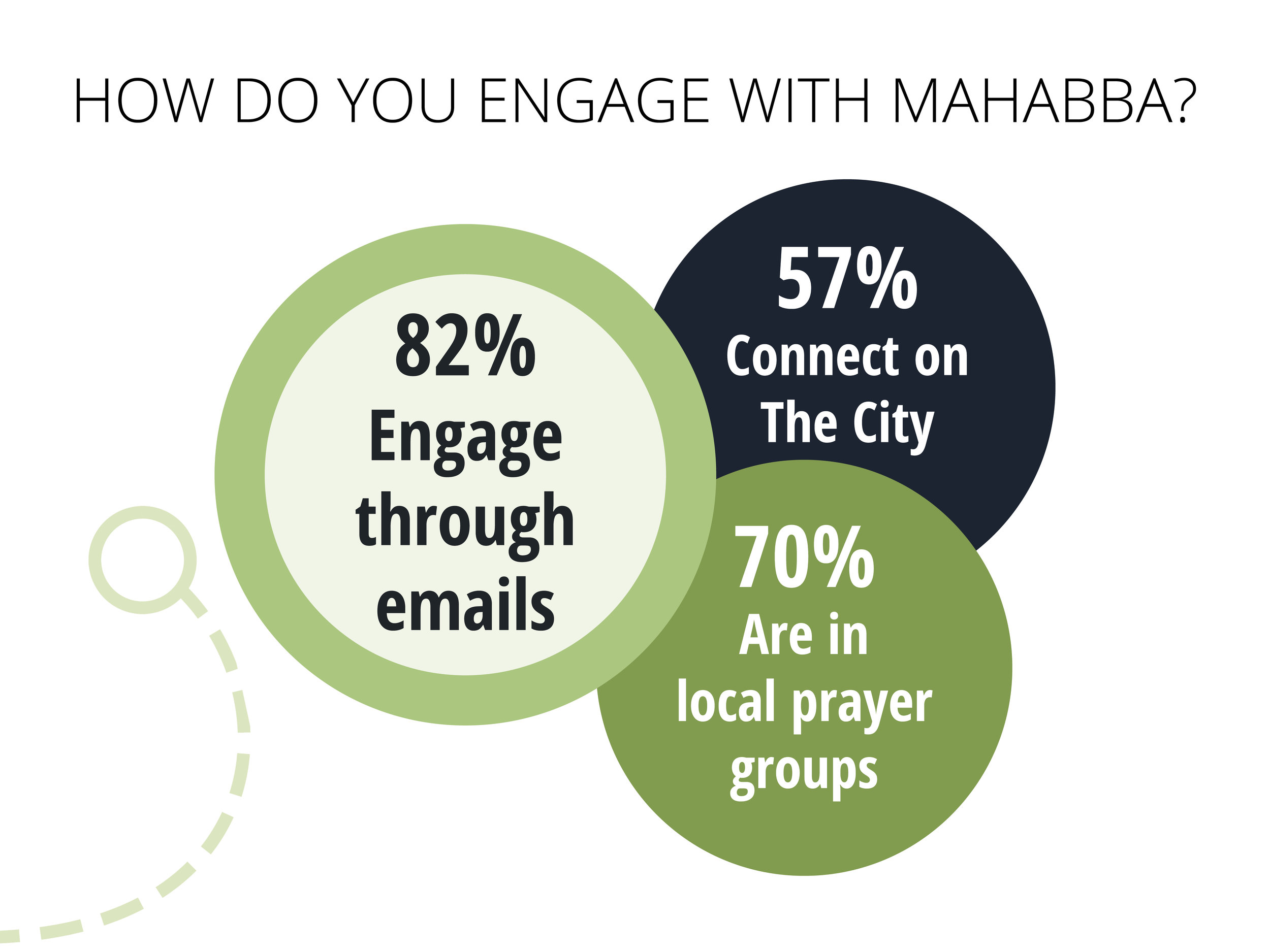
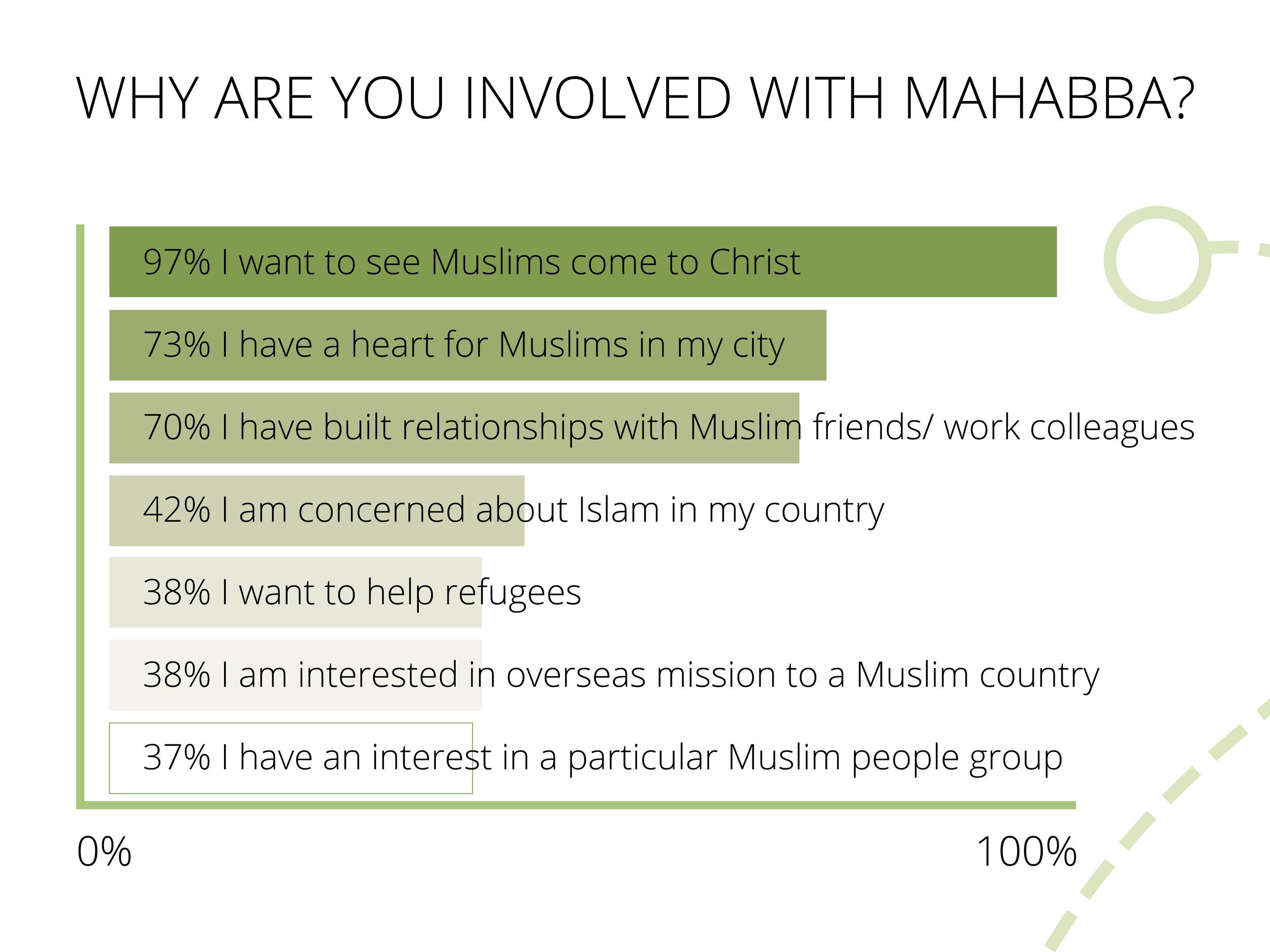
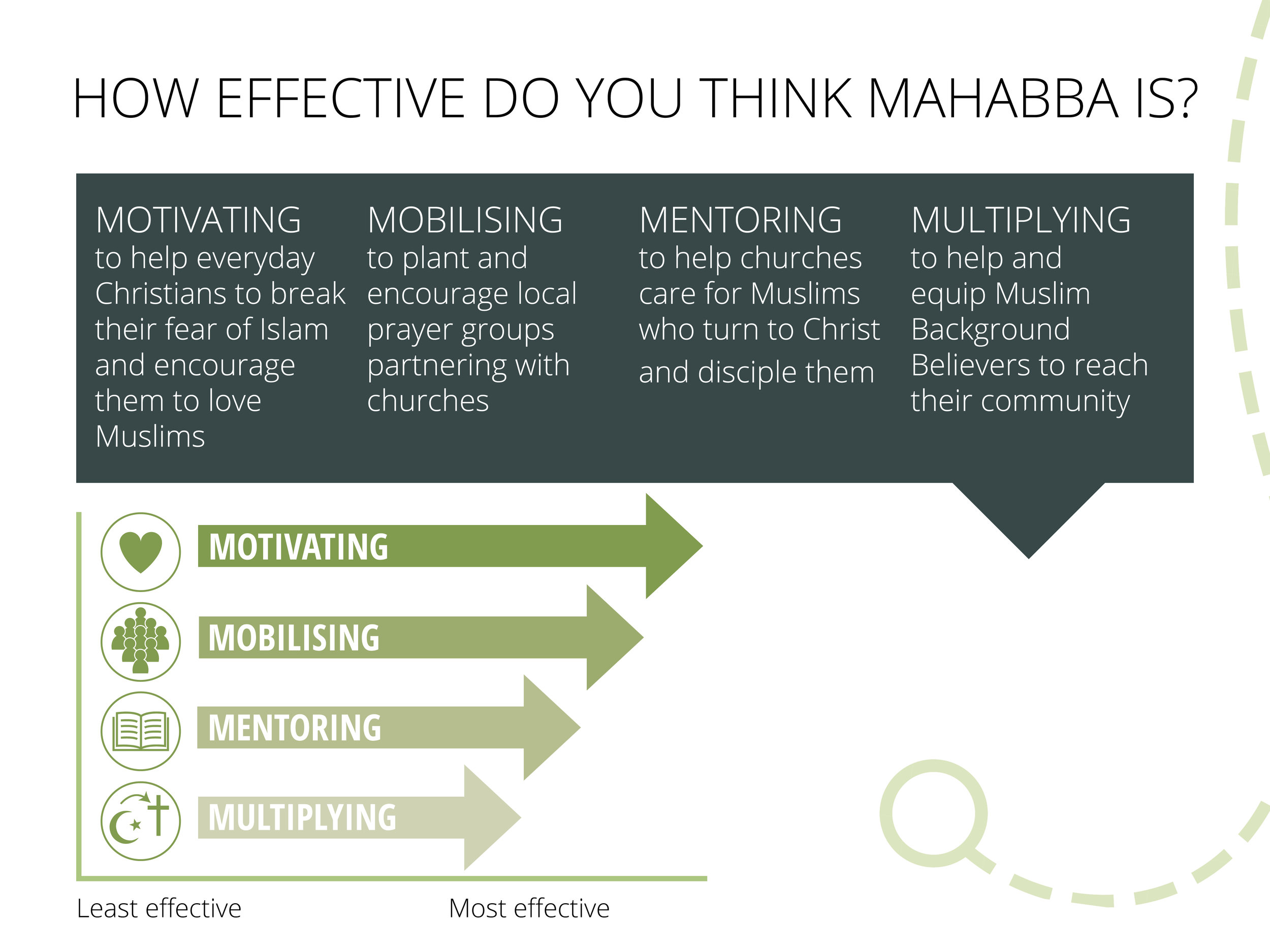
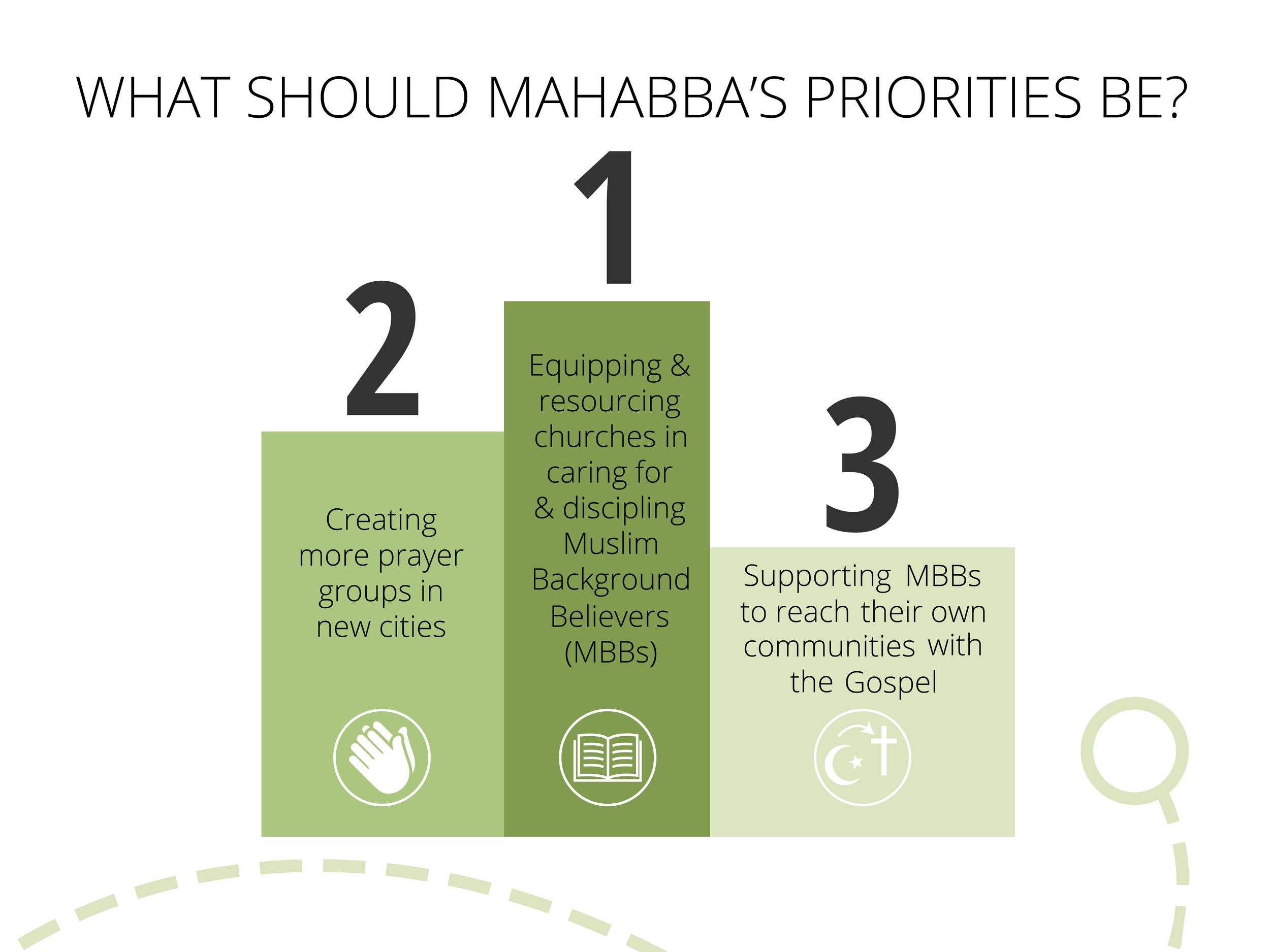
Here are the results of the survey, which was undertaken in May 2016.

You can find the full questions below the slideshow, and you can also download the result in booklet form.

Download results


Questions

How do you currently engage with Mahabba?

  • I receive emails

  • I am part of a local prayer group
  • I am a member of 'The City' online forum
  • I am in a coordination/ leadership role
  • I am a financial supporter
  • None of the above

Why are you involved in Mahabba?

  • I want to see Muslims come to know Christ
  • I have a heart for Muslims in my city
  • I have built relationships with Muslim friends/ work colleagues
  • I am concerned about Islam in my country
  • I am interested in overseas mission to a Muslim nation
  • I want to help/have a specific interest in refugees
  • I have an interest in a particular Muslim people group

How effective do you think Mahabba is at its aim of MOTIVATING – to help everyday Christians to break their fear of Islam and encourage them to love Muslims?

How effective do you think Mahabba is at its aim of MOBILISING – to plant and encourage local prayer groups partnering with churches?

How effective do you think Mahabba is at its aim of MENTORING – to help churches care for Muslims who turn to Christ and disciple them?

How effective do you think Mahabba is at its aim of MULTIPLYING – to help and equip Muslim Background Believers to reach their community?

  • Extremely effective
  • Very effective
  • Effective
  • Could be more effective
  • Could be a lot more effective
  • I'm not sure

Do you receive Mahabba emails? (such as Mahabba Matters, blog updates, emails from The City)

  • Yes, of course!
  • No, I haven't signed up yet
  • I used to, but not anymore

What do you think about the CONTENT of Mahabba's email communication?

  • Content is POOR
  • Content is GOOD
  • Content is FANTASTIC

What do you think about the FREQUENCY of Mahabba's emails?

  • The number of emails I receive is just right
  • I receive too many emails
  • I don't receive enough emails
  • Other

How often do you visit the Mahabba website?

  • About once a month
  • About once a week
  • Every few months
  • I never look at it
  • A few times a week
  • At least once a day
  • At least once a day

What do you think about the Mahabba website CONTENT?

  • Content is POOR
  • Content is GOOD
  • Content is FANTASTIC

How do you find using the Mahabba website?

  • It's OKAY to use and to find the information I want
  • It's VERY EASY to use and to find the information I want
  • It's DIFFICULT to use and to find the information I want
  • Other

Do you engage with Mahabba on social media?

  • No I don't engage
  • I don't use social media
  • Yes, on Facebook
  • Other
  • Yes, on Twitter

What should Mahabba's priorities be going forward? (Please choose your TOP, SECOND & THIRD priorities)

  • Equipping & resourcing churches in caring for and discipling Muslim background believers
  • Creating more prayer groups in new cities
  • Organising more REGIONAL events for equipping and training
  • Spending more time directly supporting and encouraging existing prayer groups
  • Supporting & empowering Muslim background believers to reach their own communities with the Gospel
  • Expanding our work into new areas (such as Europe & the US)
  • Create more prayer groups in new cities
  • Expand our work into new areas (such as Europe & the US)
  • Providing more printed and online resources to equip those already engaged
  • Organising more NATIONAL events for equipping and training

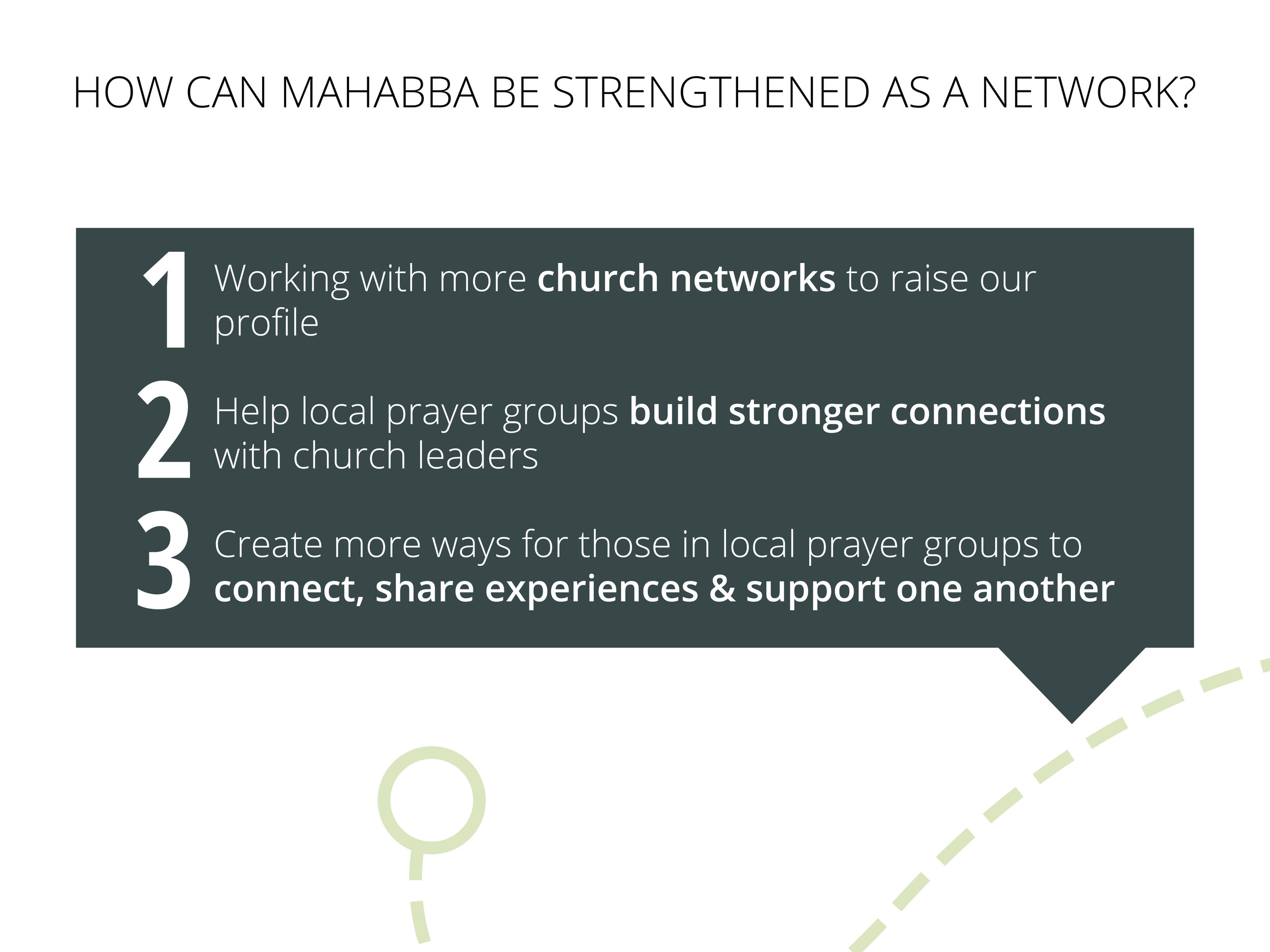
How can we make Mahabba stronger as a network? (Please choose your TOP, SECOND & THIRD priorities)

  • Work more with church networks to raise our profile
  • Help local prayer groups build stronger connections with church leaders
  • Create more ways for those in local prayer groups to connect, share experiences and support one another
  • Build and strengthen the core team to provide more support for local prayer groups
  • Create a stronger online presence to share what we do
  • Other
  • Facilitate better prayer resources
  • Organise more promotional events and activities

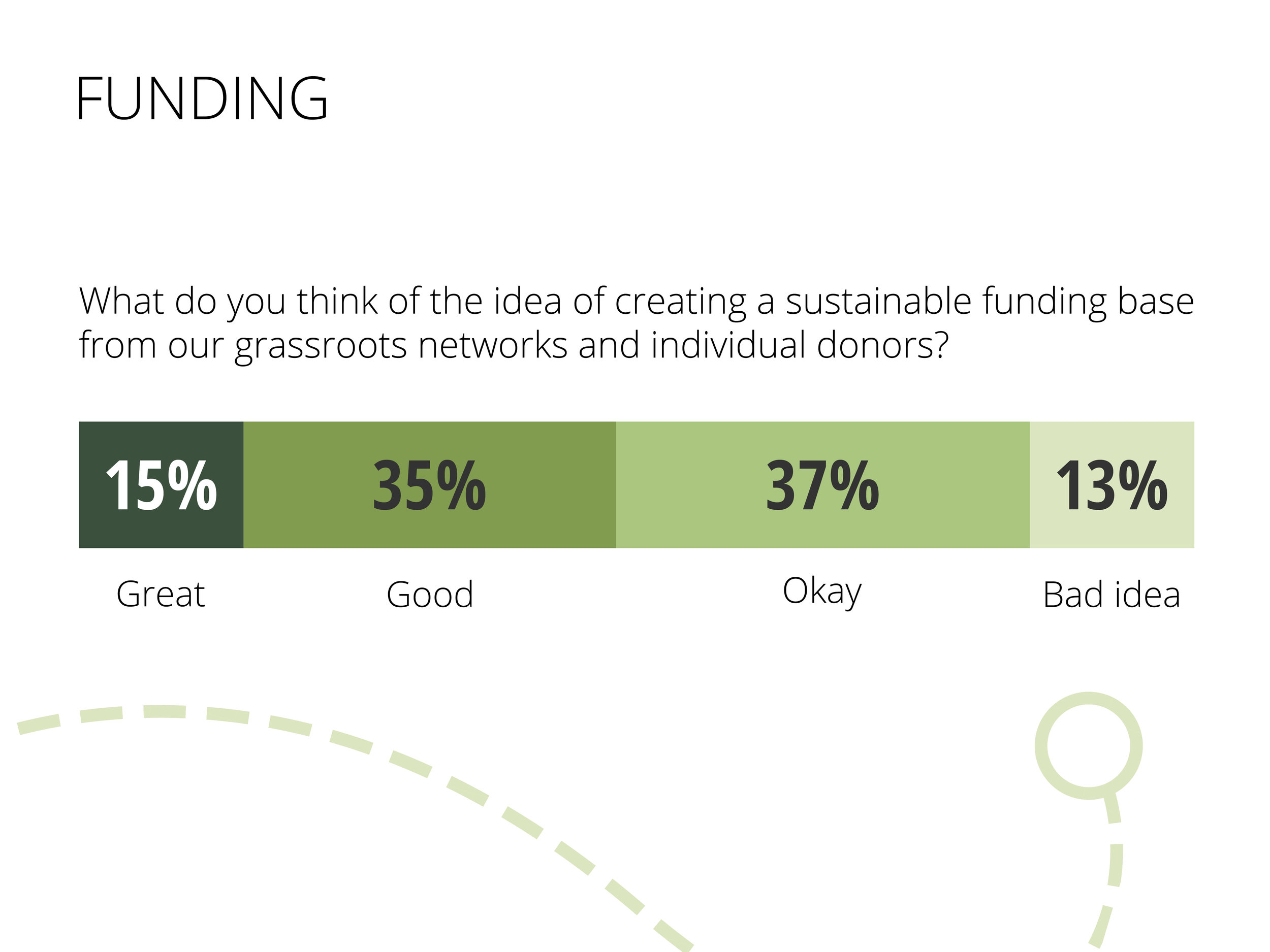
The majority of central funding for Mahabba comes from grants from charitable organisations. However going forward we want Mahabba to be more sustainable and less reliant on grant funding and look to raise funds from our grassroots networks and individual donors. 

What do you think of this idea?

  • This is an OKAY idea - I am interested to see if Mahabba can be supported by its grassroots members and individual donors
  • This is a GOOD idea - I think it would be good for Mahabba to be supported by its grassroots members and individual donors
  • This is a GREAT idea - I definitely want to see Mahabba supported by its grassroots members and individual donors
  • This is a BAD idea - I don't think Mahabba should be supported by its grassroots members and individual donors

About you - what's your sex?


About you - what's your age group? 


Are you part of a local Mahabba prayer group?