



Can a person find God in Islam? A reflection on what it means to Mahabba to know God in an intimate and personal way, in light of the Wheaton College controversy – do Christians and Muslims worship the same God.

Links to resources on sharing about Jesus with Muslims during the Christmas & New Year season.
A network member writes about a Christmas time when they invited a group of Muslims to their home.
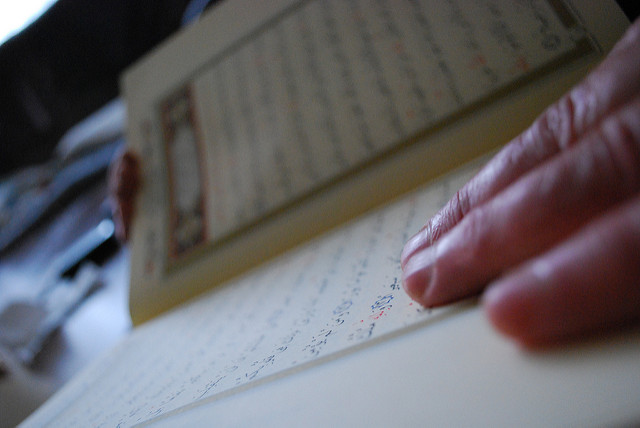
Image: Ersan Urganci, Flickr
“A friend of mine is trying to read the Qur’an and has asked for a good and short book to help her understand what the Qur’an is saying; does anyone have any good recommendations for this?”
This is a common question, and do see the existing entry below: ‘Recommended English translation of the Qur’an and introduction’.
We suggest that you first start with a translation and then move onto commentaries and secondary books.
Once you have had a chance to engage with the text itself through a translation (if you need it), have a look at the following:
Qur'an course by Jeremy Hinds from Word of Life
Leave your name, if you would like us to get back to you with further improvements or updates to the FAQ area

Image: hadock, Flickr
In the aftermath of the Paris attacks of 13 November 2015, western nations rallied around the French people in an outpouring of sympathy. The French tricolour was superimposed on Facebook images, projected onto state buildings in many countries and #prayforparis trended for a considerable amount of time. Together with these technological ways of expressing solidarity, several nations stepped up their military involvement in the Middle East and ISIS became the target of one and all.
The British parliament voted in favour of extending bombing campaigns into Syria with the argument that, “Paris could have been London.” All the historical differences and squabbles of the last couple of decades were forgotten; President Obama declared that France was America’s oldest ally despite the recent differences between France and the USA on the Iraq war.
ISIS does not discriminate against its western targets. There is a real and expressed threat facing Muslim and non-Muslim peoples alike from this terrorist band who seem to thrive on violence and destruction for its own sake. But simply calling London and Paris the same brushes over some fundamental differences in worldviews and approaches to religion in public life. Take for example the law in 2010 that banned wearing a headscarf in France to improve ‘living together.’
I was reminded of how we can differ on basic ideas that we take for granted in a recent seminar by Ravi Zacharias of RZIM ministries. Ravi was making the case that western ideas of freedom are ultimately based in biblical ideas but that freedom took different paths in western countries. He spoke of three enlightenments: the French, the English and the American.
Quoting from Gertrude Himmelfarb’s book, The Roads to Modernity (2004), Ravi listed eight things we associate with enlightenment: reason, rights, nature, liberty, equality, tolerance, science and progress. Out of this list, Reason usually tops the list for the French (and for modern secular society). The missing element from the list is Virtue which, for the British, was an essential part of enlightenment according to Himmelfarb. The British did not deny Reason but they gave it a lesser, contributory role to the qualities of compassion, kindness and sympathy, she says.
The most important difference between these two enlightenments is in the French rebellion against the church and the monarchy, summed up in the French philosopher, Denis Diderot’s wish to, “Strangle the last king with the last priest’s entrails.” As Ravi explained, the difference for both Britain and America was that religion was not the enemy. In Britain, social virtues were the driving force of political change. In America, the fight was for political freedom still based in upholding religious values, even though it was against monarchy.
The point here is not to emphasise differences between people, nor is it to have a sense of complacency about freedom of religious expression on the Atlantic side of the English Channel, or La Manche as it is called in French. Recent law suits and debates about religion in public life have shown that Anglo-American society is rethinking what it means to be secular. The aim of looking at the different expressions of enlightenment here is to think about our social values and which Light we are following in the world: To what extent does the light of the Word (Proverbs 6:23) and the Light of the world (John 8:12) form the foundation of our thinking? In Matthew 5:14, Jesus says definitively that we are a light to the world.
The question is, which en-Lightenment will we reflect to the world in the year ahead.
... we have recently reached a total of 40 local Mahabba prayer groups in the UK - awesome news!
With your help, though, we would like to continue to sow, plant and support Mahabba groups.
Our work involves a small team of regional reps and central hub personnel investing in local coordinators and groups, as well as spreading the word.
To continue this vital mission to Muslims, we need to increase our regular monthly income.
Our initial target is to raise up 100 individual regular donors, giving an average of £10 to £15 per month.
Could you be one of the 100?
BBC NEWSNIGHT REFUGEE POLL
Poll of 1000 British adults about the migrant crisis for BBC Newsnight
Here are the key findings from the ComRes poll for the programme.
Read the poll and its findings in full on the ComRes website.

Image: digimist, Flickr
Mahabba is regularly on the road, encouraging and equipping everyday Christians and church leaders – God is on the move among Muslims and we have a part to play.
Out of the blue in The Hub, we heard from Andy, a church leader in St. Austell, Cornwall. He had been impacted by a conversation with Mahabba Network’s UK Director, Gordon Hickson.
“As Gordon shared about the work of Mahabba, I was struck by the impact that the work was having with Muslims, not only globally, but also within the UK as well.”
He added light-heartedly,
“We’re based in St Austell, so probably one of the least Muslim areas of the country!”
As it happens, Andy was not far off the mark.
In the 2011 Census, Cornwall recorded one of the lowest concentrations of Muslims in England and Wales, with 0.2% of its population stating its religion as Islam [Source 2011 Census].
In contrast, Tower Hamlets – a borough in East London, where Mahabba has a prayer group – recorded 34.5%, making it the local authority with the largest concentration in the UK.
Here is how Cornwall comes in the standings:
Government office for the region (South West)
Bottom with 1%, 51,000 Muslims
County
[N/A Cornwall is not designated as a county]
Local Authority
In the bottom 15% of LAs, with 0.2%, 850 Muslims
Ward
Wadebridge East is in the bottom 3% of over 8,500 wards in the UK
At the end of the conversation, Andy asked to be kept up to date with the work of Mahabba so that he could feed things back to the rest of the leadership team here.
Mahabba continues to spread the word about Muslims around the UK: that Christians need to face the facts, but not fuel the fear.
Muslims are here to stay, and we have a responsibility to love and pray for them.
Whether you find yourself in an area with many Muslims or not, you can have an impact.
Why not request a church visit like Andy, so you can find out more about Muslims and Islam and how you can engage?
