
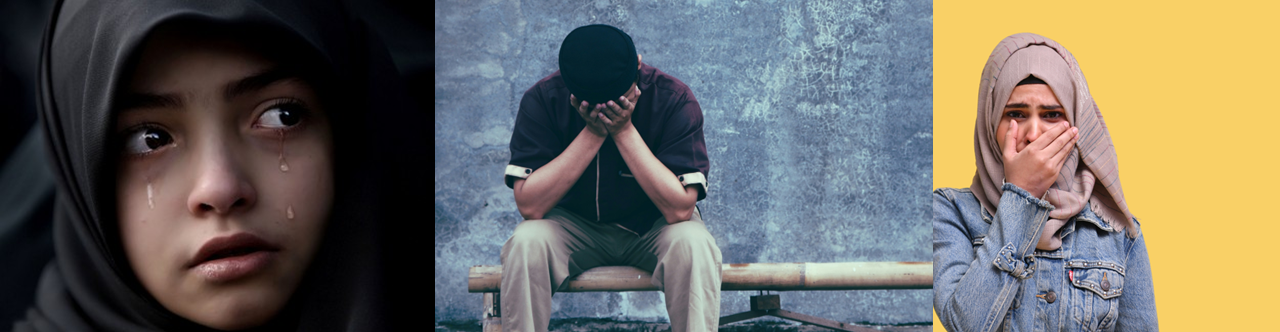
The UN has designated March 15th an International Day to Combat Islamophobia.[1] How does that make you feel?
My guess is that most people reading this are Christians and that there would be a range of responses to my question. I suspect that our Muslim neighbours would also react in a variety of ways. Maybe we should ask them? Some, I suspect, would shrug and say it will make no difference. For others, it would touch a raw nerve and might reignite some anger or hurt, perhaps accompanied by a mix of hope and pessimism. Some, I am sure, would feel that shining the spotlight on their community is likely to make things worse, not better.
Back to us Christians. What do we feel about it? When I was younger, I only knew of Islam as something far away that was responsible for the persecution of Christians. Friends who come here from Pakistan or Nigeria do have harrowing stories. It seems a bit rich talking about standing up for Muslims. Isn’t Islam something we ought to be afraid of?
First, let’s deal with the vocabulary.
The term Islamophobia, for whatever reason, is used to refer to a generalised hostility towards people who are Muslim. It is not primarily about Islam as a set of beliefs and practices. Ordinary Muslim people who may be non-practising, agnostic or even atheist experience this hostility just as much as the devout. It is about their identity, not what they believe. This makes it a form of racism. It is about othering them on the basis of their group identity. Should there be a different term for it? Probably, but we don’t get to decide what words mean. In the meantime, as Christians, we have the command of Christ to love our neighbour. Do we know or care what our (Muslim) neighbours are experiencing?
Eye Witness Reports
In 2017, a BBC journalist produced a superb report on the experience of living as a Muslim woman in Britain.[2] She spoke to women from a range of backgrounds. She reported on verbal and physical expressions of hate from complete strangers and the impact it has. She also explored the more subtle issues that arise when someone asks a woman born and bred in the UK, “Do you consider yourself British?” There is a consensus among people who monitor these trends that the problem is becoming more intense at the moment, not less.
In December 2025, Guardian journalist Taj Ali posted a report.[3] Among other things, he talked to a young British Muslim man who was struggling with how to answer his children when they asked whether they belonged here or not. The rising support for the far right expressed by certain politicians and some campaign groups continue to raise the tension that ordinary Muslim people feel in their daily lives. I had the privilege of listening to Hasna Khatun, a former Muslim now Christian minister, talking about the impact of the surge of flag raising during the summer of 2025. She spoke movingly of how intimidating it was for those who were not ethnically English. As Christians, if we know a behaviour causes harm to our neighbour, we should not be insisting on our rights.[4]
Calling Out Islam
Isn’t it important that we “call out” Islam? If we are called to stand for the truth of the gospel, don’t we have a responsibility to make identifying with Islam uncomfortable? At this time and in this place, I believe the answer is no and I will give two reasons.
One is that right now Islam is already tearing itself apart. Social media is full of claims and counter-claims being made by teachers, doubters and former Muslims. Things are being discussed by ordinary Muslims which they never used to hear. Many are disoriented. They need friends who listen to them in their confusion, not additional enemies.
The second reason is that although Christians feel relatively marginalised in the UK, we are perceived as representing the majority. Muslims feel themselves to be a vulnerable minority. When we choose to address them by critiquing Islam uninvited, we seem to be aligned with the hostile majority, bullying the weak. If we want them to hear what we have to say, they have to know first we are on their side, that we want what is best for them. If we appear to be in attack mode, that won’t happen. We just blend in with the hostile noise. If we follow the apostle Paul’s advice that our conversation be always full of grace, seasoned with salt,[5] we will invite the questions which we want to answer.
There is much confusion around these issues. In our fellowships and churches, there may be a variety of voices on this subject. To be better equipped to speak up, I can only recommend Karamat Iqbal’s recent publication Islamophobia. What it is and why it should matter to Christians.[6]
[1] https://www.un.org/en/observances/anti-islamophobia-day
[2] https://www.youtube.com/watch?v=WsDjIMg2k1o
[3] https://www.youtube.com/watch?v=RojgoADuoVA (Contains some offensive language).
[4] Romans 14:15; 1 Corinthians 10:29-33
[5] Colossians 4:6
[6] https://www.mcsci.org.uk/resources/publications-np/islamophobia/